The Vanishing Vernacular Gardens of the Rural South
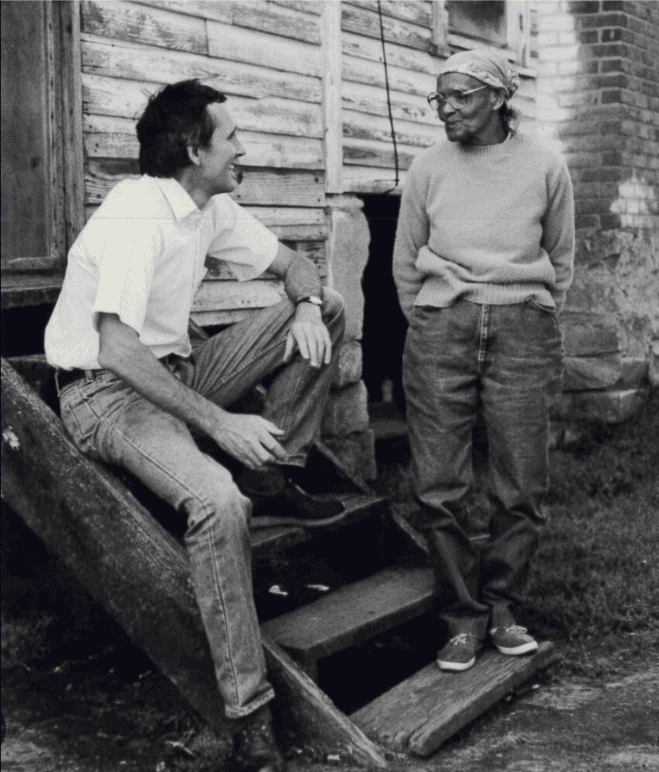
Oglethorpe County is known for its roots in rural life and brings in a vital industry, agriculture. Yet beneath that visible landscape is another history, one that landscape architect and scholar Richard Westmacott has spent much of his life documenting: the disappearing vernacular gardens and yard spaces of African American families in the rural South.
Richard Westmacott, a landscape architect who resides in Oglethorpe, claims the importance of the agrarian life is the homeplace, self-sufficiency and hard work. The appeal of living an agrarian lifestyle brought Westmacott to Oglethorpe County in 1977 after a job offering at the University of Georgia in the College of Environment and Design. Westmacott says in London the African American scene was urban compared to Oglethorpe. He grew a connection among the shared love for urban life in the community.
Westmacott found a hobby in fixing up derelict houses and starting his African American gardening studies. Westmacott describes himself as an agricultural historian than a landscape architect. Much of his early connection to the community came through his wife, Jean Westmacott, who operated a daycare program that functioned as an early version of Head Start in Oglethorpe County. Through those relationships, Westmacott began visiting local families. On his trips, he was taken aback by the vernacular gardens and the use of self sufficiency families had developed.
In his book African-American Gardens and Yards in the Rural South, Westmacott challenges the traditional hierarchy of landscape study. “The study of landscape agriculture,” he writes, “is often the study of parks and gardens of the wealthy, while vernacular gardens are not considered as worthy academically and yet I saw in these places an extraordinary range of resourcefulness that needed to be pursued.”
Those “vernacular” yards shaped by necessity, memory, and care, became central to his research. Through interviews, measured drawings, and physical documentation across South Carolina, Georgia, and Alabama, Westmacott traced patterns of design that carried both practical and cultural meaning. He also explored possible West African influences, including traditions such as the swept yard, while noting the shared but differently expressed values of agrarian life across racial lines in the South. Despite their significance, Westmacott has repeatedly emphasized how easily these landscapes are overlooked. He notes that African American gardens are often under-documented and under-photographed, not because they lack beauty or complexity, but because they fall outside traditional definitions of what is considered “worthy” preservation.
Melissa Tufts, retired director of the Owens Library and Circle Gallery at UGA’s College of Environment and Design, said “formal gardens of elites were mainly in the southern garden exhibits, but now after the Richard Westmacott exhibit in 2020 there was a bridge to the gap of understanding these beautiful vernacular landscapes.”
Westmacott states over the several yard gardens he did his research on in Oglethorpe, over half are gone today. Across the south, he describes the Black youth as flooding into cities rather than rural areas. Preservation of the yard gardens is nonexistent.
The trend of decreasing gardens to Westmascott is due to the lack of jobs for African Americans rurally, the missing generation of children who moved to the city, and the low social status of working on the land. For Westmacott, the concern is not only what has been lost, but what is at risk of being forgotten. The disappearance of these gardens signals more than a change in landscape; it marks a quiet shift in how history is held, and who gets to define what is preserved.
As he has often suggested, the future of these traditions may depend on what he calls the “missing generation” returning, not only to the land itself, but to the stories embedded within it.
Richard Westmacott was a professor of landscape architecture at the University of Georgia from 1977 until his retirement in the early 2000s. His specialties include rural conservation and landscape engineering. His notable publications include, African-American Gardens and Yards in the Rural South and New Agricultural Landscapes